Tuesday, March 8, 2016

Equilibrium

What is Equilibrium?

Equilibrium is the state at which opposing forces are balanced. The force as well as torque both equal zero. The forces don't always have to be equal as shown int eh picture below but they do have to be equal. An object can be moving and still have a state of equilibrium as long the center of mass is moving at a constant velocity.


Torque:

"A torque is an influence which tends to change the rotational motion of an object."
Torque is a measure of how much force is acting on an object that causes the object to rotate. In this picture, the force is going down on the radius (lever) at a point that is called the pivot point. The torque will rotate around the pivot point.

One equation of torque is =Fr


This is like one of the problems we did in class. We had the force and the radius and we just multiplied them together to find the torque of the wrench.

Some Types of Equilibrium:

Hyperbolic Equlibrium

Physics Equilibrium:
  • Equilibrant Force: considered to be the equal and opposite of the resultant force
  • Equilibrium Mode Distribution: a state in which power is distributed to all modes equally
  • Hydrostatic Equilibrium: the pressure at any point in a fluid is at rest is due to the weight of the overlying fluid
  • Hyperbolic Equilibrium Point: a fixed point that does not have any chambers branching into openings.
  • Mechanical Equilibrium: a state where there is no physical change. It is known a s a state of steadiness
  • Radiative Equilibrium: the temperature of an object is constant with the time
  • Secular Equilibrium: a situation when the quantity of a radioactive isotope remains constant. This is because the production rate is equal to the rate of decay

Chemistry Equilibrium:

  • Thermodynamic Equilibrium: when two objects are in thermodynamic equilibrium with a third object, hey are in equilibrium with each other. "It is observed that some property of an object, like the press in a volume of gas, the length of a metal rod, or the electrical conductivity of a wire, can change when the object is heated or cooled. If two f these objects are brought into physical contact there is initially a change in property of both objects. But eventually, the change in property stops and the objects are said to be in thermodynamic equilibrium."
  • Chemical Equilibrium: there is a constant ratio between the products and the concentration of reactants.
  • Diffusive Equilibrium: state at which the concentrations of diffusing substances in two compartments become equal to each other.
  • Thermal Equilibrium: state where one object has a higher temperature than the other one. When they become closer to having the same temperature, they become a state of thermal equilibrium.
  • Donnan Equilibrium: the equilibrium of small ions between a solution with charged macromolecules and one without.
  • Dynamic Equilibrium: when the rate of a forward reaction is equal to the rate of a backward reaction
  • Equilibrium Constant: the constant is usually expressed in a form of "k". It is the relationship between reactants and the products of a reaction.
  • Partition Equilibrium: this is a special id of chemical equilibrium because it is equilibrium of different substances at different phases.
  • Quasistatic Equilibrium: a thermodynamic process that happens slow enough so that the system can remain in internal equilibrium 
  • Schlenk Equilibrium: a chemical equilibrium that takes place in solutions of Grignard reagents 2 RMgX MgX2 + MgR2.
  • Solubility Equilibrium: " Solubility equilibrium is based on the assumption that solids dissolve in water to give the basic particles from which they are formed"
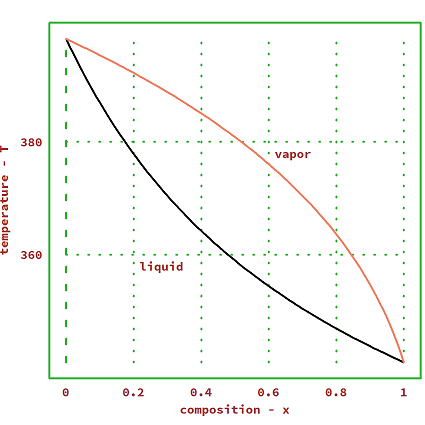
  • Vapor-liquid Equilibrium: VLE is a condition in which a liquid an dits vapor are in equilibrium with each other. The rate of evaporation is equal to the rate of condensation.
    Vapor Liquid Equilibrium

Biology Equilibrium
  • Equilibrioception: sense of balance in a physiological sense
  • Equilibrium Unfolding:the process of unfolding a protein or RNA molecule by changing its environment. For example, changing the temperature or applying some sort of force.
  • Genetic Equilibrium: a condition where the alleles do not change from generation to generation
  • Homeostasis: "the property of a system in which variables are regulated so that internal conditions remain stable and relatively constant."
  • Punctuated Equilibrium: a theory that suggests that a species has been stable and most likely shows very little change for most of its history
  • Sedimentation Equilibrium: "it is an analytical ultracentrifugation method for measuring protein molecular masses in solution and for studying protein to protein interactions."
Along with these equilibriums, there are examples of equilibriums in economics as well as game theory.

States of Equilibrium:

  • Neutral Equilibrium: a kind of equilibrium so that with a small or insignificant change, it still
    remains in a state of equilibrium. An example of this is a sphere rolling on a flat surface. If it is stopped at any point, it will be in equilibrium.
  • Unstable Equilibrium: a kind of equilibrium so that when the object is slightly changed, it go further from its original position.
  • Stable Equilibrium: a kind of equilibrium so that with a small change, forces emerge which help return the object back into a state of equilibrium. An example of this is when the center of gravity is below the point of support. 
  • Static Equilibrium: a kind so that when the system is at equilibrium, the forces will equal zero. When, the forces acting on the object are at rest, they are in a state of static equilibrium. An example is 
    In this picture, 
         A is neutral equilibrium
         B is stable equilibrium
         C is unstable equlibrium

Equilibrium in the Human Body:

Equilibrium in the human body allows for humans to stand up straight and allows them to walk. Equilibrioception also relates to the human body because it is the balance of a humans physiological sense. A huge part of this a humans center of gravity. If their is more mass to one side of their body, the human must compensate for it or they will fall over. As shown in the picture, each center of gravity or mass is different because of the way their body is and what they are carrying.


Bibliography:

http://chemwiki.ucdavis.edu/Core/Physical_Chemistry/Equilibria/Chemical_Equilibria/The_Equilibrium_Constanthttp://hyperphysics.phy-astr.gsu.edu/hbase/thermo/thereq.htmlhttp://www.academia.edu/568899/General_Equilibrium_Theory_its_history_and_its_relation_if_any_to_the_Market_Economyhttp://en.fphysics.com/states_of_equilibriumhttps://isaacphysics.org/concepts/cp_equilibriumhttps://www.shodor.org/unchem/advanced/equ/http://www.merriam-webster.com/dictionary/unstable%20equilibriumhttps://www.khanacademy.org/science/chemistry/chemical-equilibriumhttps://www.khanacademy.org/search?search_again=1&page_search_query=equilibriumhttp://www.thefreedictionary.com/Unstable+equilibriumhttp://www-rohan.sdsu.edu/~aty/explain/thermal/hydrostatic.htmlhttps://www.grc.nasa.gov/www/k-12/airplane/thermo0.htmlhttp://dev.physicslab.org/document.aspx?doctype=3&filename=dynamics_staticequilibrium.xmlhttps://www.chem.tamu.edu/class/majors/tutorialnotefiles/ksp.htmhttp://apollo.lsc.vsc.edu/classes/met130/notes/chapter2/rad_equil.htmlhttp://www.britannica.com/science/equilibrium-physics
http://hyperphysics.phy-astr.gsu.edu/hbase/torq.html
https://www.physics.uoguelph.ca/tutorials/torque/Q.torque.intro.html

Monday, January 25, 2016

Programming


What is Programming?


          "Programming is the process of taking an algorithm and encoding it into a notation, a programming language, so that it can be executed by a computer."
          "Programming is the process of designing, writing, testing, debugging, and maintaining the source code of computer programs."

Computer Programming is the process of telling a computer what to do though programming languages. It is the process of creating a sequence of instructions that tells a computational device what to do.The specific program is interpreted by a computer and then it preforms the task it wa told to do.

Types of Programming Languages:


In 2015, the top 10 programming languages were:

  • C: this program is widely known and gives maximum control and efficient to the programmer. C allows you to create lists for your computer to follow. It is an easy language to learn and is a compiled language. The C program is in human readable form that is then put through a C compiler for your computer to read and follow.
  • C++: this program is an extension of C. It is most commonly used with system/application software, drivers, client-software applications and embedded firmware.
  • C#: It was developed by Microsoft. It is a multi-paradigm programming language. "C# has strong typing, imperative, declarative, functional, generic, object-oriented, and component- oriented programming disciplines."
  • Java: it is a programming language that was designed to look and feel like the C++ language but a lot simpler. It was designed for the use of the internet. This language can be used to create complete applications that run on a single computer and it can also create small applications for a web page.
  • JavaScript: it is a high-level, dynamic, untyped, and interpreted program. It is a subset to Java
  • Python: this program is like a glue language that helps to connect existing components together.It consists of dynamic semantics.
  • R: this program is a free software environment for statistical computing and graphics. It run on a wide variety of UNIX platforms.
  • PHP: this is a programming language that the server is a server-side HTML embedded scripting language
  • Matlab: it is a mathematical scripting language that is very similar to C++. Some features of this language includes easy creation of scientific and engineering, efficient matrix and vector computations, and application development, including graphical user interface building.
  • Ruby: it is a dynamic, reflective, object-oriented, general purpose programming language developed in the mid-1990s in Japan. 
This is the ranking of the top 10 programing languages of 2015


History of Programming:

  • The first computer programmer was Ada Lovelace. In 1842, she described the algorithm as the first computer program. She also theorized that one day a computer could play music and chess.
  • In 1889, Herman Hollerith developed the idea of the electric tabulating system. This was a machine that could read data. He also created the tabulator and keypunch machine. 
  • In 1906, Herman Hollerith developed a plugboard that allows for the computer to multitask and do many things without reconstructing it each time.
  • In 1937, the first electronic and digital computer was created to solve linear equations.
  • In World War II, the Colossus machines were the first programmable, electronic, digital computers. Those machines were used to decrypt German messages
  • In 1947, Grace Murray Hopper detected the first actual computer bug.
  • In 1949, the Electronic Delay Storage Automatic Calculator ran its first program to calculate a table of squares and find a list of prime numbers.
  • In 1954, the first high level computer programming language was created by John Backus and it was called Fortran.
  • In 1961, the first computer game was created. It was called Spacewar and it took over 200 man hours to complete
  • In 1983, the first computer virus was created by Fred Cohen. This was a hidden program that could infect other computers with the use of a floppy disk.

Programming Jobs:


          In this picture, it shows the different programming languages along with the variety of jobs and the amount of money that goes along with these different jobs. Programming is one of the most attractive fields these days. There is a good amount of money to make and a lot of positions open. The highest computer programming salaries are in the United States. The second country is Russia. The China, Ukraine, Philippines, and India. In the U.S. the average amount of money made is about 60,000 dollars. Above, it also shows the different salaries that people make depending on their job.


Bibliography:

http://earsketch.gatech.edu/category/learning/anatomy-of-an-earsketch-project/what-is-programming
http://interactivepython.org/courselib/static/pythonds/Introduction/WhatIsProgramming.html
http://landofcode.com/programming-intro/summary.php
http://spectrum.ieee.org/computing/software/the-2015-top-ten-programming-languages
http://computer.howstuffworks.com/c1.htm
http://searchsoa.techtarget.com/definition/Java
http://www.crockford.com/javascript/javascript.html
https://www.python.org/doc/essays/blurb/
https://www.r-project.org
http://www.codingunit.com/php-tutorial-language-introduction
http://groups.engin.umd.umich.edu/CIS/course.des/cis400/matlab/matlab.html
http://lifehacker.com/the-programming-skills-jobs-and-company-types-that-pa-1692152608
http://holykaw.alltop.com/the-history-of-computer-programming-infograph


Tuesday, December 15, 2015

Technological Singularity


What is the technological singularity?

               The technological singularity is the period in time when technology and artificial intelligence will out preform human intelligence. This can have very far reaching effects on human society and all aspects of civilization. It can affect the course of human history because machines and computers can learn at a faster rate than humans.

There are several ways by which it is possible for science to achieve this breakthrough.

  1. The idea that there may be developed computers that are "awake" and superhumanly intelligent
  2. There are large computer networks that may possibly "wake up" as a superhumanly intelligent entity.
  3. Computer and human interfaces may become so intimate that users may reasonably be considered superhumanly intelligent
  4. Biological science may provide means to improve natural human intellect
The first three ways depend strictly on the progress of computer hardware. Over the last few decades, the progress in this has followed a steady curve.


ASI: Artificial Superintelligence

     
          When people are asked to think of a super smart computer, they mainly think of a computer that thinks like a human brain but much, much faster. A true separator between humans and the ASI would be the intelligence quality. An example of this is between chimps and humans. Chimps are not even able to grasp the world that we live in today. Even if you speed up a chimps brain a thousand times, it would not match the intelligence of humans today. Chimps are able to see humans and for example, skyscrapers, but they would not be able to comprehend that it was built my humans. The chimp to human intelligence quality is much tinier than human to the ASI.


History and Future of the technological singularity:

             There are several dates predicting the singularity. They range from 2017-2112. This is a time where computer based intelligence will exceed what the human brain is capable of. This expansion in technology continues to grow exponentially. It is because of this rapid growth that it becomes very difficult to predict how future human lives will be affected by this. 

              In the mid 1950s,  the term "singularity" was first used in context by John von Neumann. He spoke about the rapid progress of technology which can lead to some important singularity in the history of the race beyond human affairs that could not continue. Later, a science fiction writer by the name of Vernor Vinge popularized the phrase technological singularity. Vernor VInge thought that artificial intelligence, human biological enhancement, or brain computer interfaces could all be causes of the singularity. He predicts that the singularity will come some time before 2030. Another person who has been credited with this concept is Ray Kurzweil. He predicts that the singularity will occur around 2045. With Stuart Armstrong and his findings, he predicted that the singularity will occur some time between 2017 and 2112. With the increasing amount of power in computers and other technologies, it might be possible to create and build a computer that can out think and become more intelligent than  humanity. Alan Turing once said, "Once the machine thinking method has started, it would not take long to outstrip our feeble powers." At some time in the future, we should expect for the computers to take control. The arrival of the singularity will probably occur faster than any other technological revolution that we have seen so far. When it occurs, people will be in the post human era. 

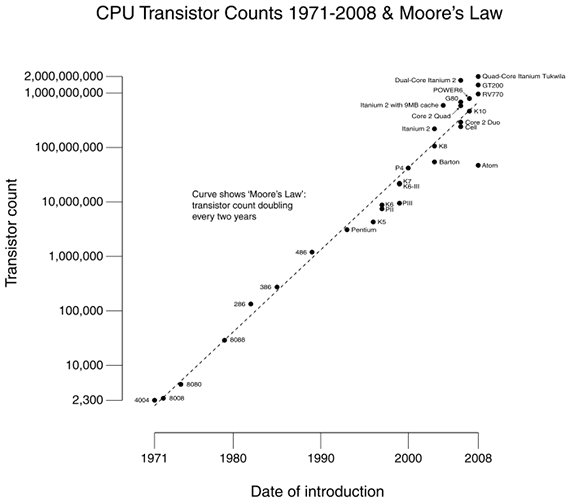
Moore's Law helps to explain the growth rate or speed as to how fast they preform. It can be theorized that the processing speed of these components double every two years. Other factors also come into play. This law mainly applies to transistors but can also refer speed. 


Consequences of this event:

              The progress of human intelligence will become more rapid when greater human intelligence drives the progress. An analogy for this is "Animals can adapt to problems and make inventions, but ofter no faster than natural selection can do its work" Relating this to humans, "Wh humans have the ability to internalize the world and conduct "what ifs" in our heads; we can solve many problems thousands of times faster than natural selection. Now, by creating the means to execute those simulations at a much higher speeds, we are entering a regime as radically different from our human past as we humans are from the lower animals."


  There are 8 main consequences of the technological singularity coming:
  • Extinction
    • Out of all these possible consequences, extinction is definitely one of the most feared. 
      Mitochondria
    • Some scientists fear that humans are gradually becoming mitochondria. Mitochondria were once independent organisms but later let cells take over all of their functions until the only thing they were able to do is produce energy
      • Joan Slonczewski said, "We're becoming like mitochondria. We provide the energy.
  • Slavery
    • Once we have AIs, humans stop being the smartest things on this planet. People think that if the AIs decide not to exterminate humans, they will enslave us. 
  • World War III
    • A possible outcome of the clash between the human race and AIs is a World War III. This war may lead to an unprecedented scale, sophistication and efficiency of death and destruction. 
  • Economic Collapse
    • If there is complete robotization in our society, this will most likely lead to the overproduction of goods and services. People think that people will loose their jobs to robots.
  • Big Brother AI
    • This option is a milder version of the slavery option. Humans are still under the control of the AI. The difference between this and slavery is that the Ai is doing what is best for the people rather then enslaving people and doing hat is best for itself. 
  • Alienation and Loss of Humanity
    • In this scenario, people think that it might be possible to survive the singularity by merging with the machines. This idea is referred to as transhumanism. With the merge of humans and artificial intelligence, it would increase our abilities tremendously. The major fear by doing this is that humans might loose the very essence of being human which can lead to a loss of community
  • Environmental Castorhpe
    • If humans live in a world were everything is mass produced by robots, humans would loose the last bit of respect for mother nature. 
  • Fear of Change
    • Humans want to be comfortable. The fear of change and the fear of the unknown is not comfortable. 

Bibliography:

http://www.singularitysymposium.com/definition-of-singularity.html
http://mindstalk.net/vinge/vinge-sing.html
http://www.livescience.com/29379-intelligent-robots-will-overtake-humans.html
http://waitbutwhy.com/2015/01/artificial-intelligence-revolution-2.html
Technological Singularity by Vernor Vinge 1993


Monday, December 14, 2015

Robotics, Robots, and Programing


A Robot is a machine capable of carrying out a complex series of actions automatically, especially one programmable by a computer. They also enhance human activities
              The word robot was created in 1921 when a Czech writer invented it. In the Czech language, "Robot" comes from the word "boot" meaning compulsory labor.

Robotics is the branch of technology that deals with design, construction, operation, and application of robots.

Programming is to provide a computer or other machine with coded instructions for the automatic performance of a particular task


The History of Robots:


Water Clock
  • Although Aristotle is an idiot, in 322 B.C., he said that, "If every tool, when ordered, or even of its own accord, could do the work that befits it... then there would be no need either of apprentices for the master workers or of slaves for the lords.”
  • 200 B.C., a Greek inventor and physicist designed a water clock that had movable figures that was able to tell time by the force of the water passing through it at a constant rate.
  • 1495: Leonardo da Vinci drew up plans for a humanoid robot
  • 1700-1900: a great deal of automatons were created during this time
    The Duck Automata
  • 1738: Jacques de Vaucanson begins building a set of three automata. The first was a flute payer who could play twelve songs. The second on was able to play a flute and a drum. His third automata was his most famous. It was "The Duck". It was an attempt in modeling human or animal anatomy with mechanics
  • 1770: Swiss clock masters and inventors invented the wristwatch
  • 1802: Joseph Jacquard builds an automated loom which is controlled with punched cards. Later on, punched cards are used as an input method for some of the 20th centuries
    Remote Controlled Robot Boat
    earliest computers
  • 1898: Nikola Tesla creates a remote controlled robot boat
  • 1913: Henry Ford installs the world's first moving conveyor belt based assembly line
  • 1926: first robot to be projected in a film
  • 1932: The first actual robot was constructed and  produced in Japan. The "Lilliput" was a windup toy that walked. Its total height was 15 centimeters
  • 1936: Alan Turing introduces the concept of a theoretical computer called the Turing Machine.
    Alan Turing
    In 1937, he releases his paper on Computable Numbers. This begins the computer revolution
  • 1940: Isaac Asimov writes a series of short stories which he describes the Three Laws of Robotics

    1. A robot many not injure a human being, or, through inaction, allow a human being to come to harm
    2. A robot must obey the orders given it by human beings except where such orders would conflict with the First Law
    3. A robot must protect it own existence as long as such protection does not conflict with he First or Second Law
    4. Later on, he added the "Zeroth Law" which states
      that a robot may not injure humanity, or, through inaction, allow humanity to come to harm
  • 1950: Alan Turing propses a test to deterimne if a machine turly has the power to think for itself. This test became known as the "Turing Test." In order to pass the test, a robot or machine must be able ti indistinguishable from a human during conversation
  • 1954: George Devol and Joe Engleberger design the first programmable robot arm. Later, this becoems the first industrial robot used for completing dangerous and receptive tasks on an assembly line.
  • 1956: Alan Newell and Herbert Simon create the Logic Theorist. This was a system that was used to help solve difficult math problems
  • 1957: The Soviet Union launches "Sputnik", into space. This was the first artificial orbiting satellite. By doing this, it marked the beginning of the space race
    Launched by the Soviet Union
  • 1961: Heinrich Ernst develops the MH-1, a mechanical computer operate by a mechanical hand at MIT
  • 1964: The IBM360 becomes the first computer to be mass produced
  • 1966: Stanford Research Intestate creates Shakey, the first mobile robot to know and react to its own actions
  • 1967: Richard Greenblatt writes a program that plays chess. This program becomes the foundation for many future chess programs
  • 1969: Victor Scheinman creates the Stanford Arm. This arm's design is still influencing the design in robots today
  • 1969: The U.S. uses the latest competing, robot, and save technology to successfully land Neil Armstrong on the moon
  • 1974: Victor Scheinman starts marketing he Silver Arm which is capable of assembling small parts together with the use of touch sensors
  • 1976: in Japan, Shigep Hirose designs the Soft Gripper which is designed to wrap around an object in a snake like fashion
  • 1977: The first Star Wars movie is released. This move features robots such as R2-D2 an C-3P0
  • 1977: Deep space explores Voyagers 1 and 2 are launched from Kennedy Space Center
  • 1981: Takeo Kanade builds a Direct Dive Arm. There are motors installed directly in the joints of the arm allowing for it to become faster and much more accurate
  • 1986: The first LEGO product comes to the market
  • 1986: Honda begins a robot research program. It starts with the statement that "the robot should coexist and cooperate with human beings, by doing what a person cannot do and by cultivating a new dimension in mobility to ultimately benefit society"
    CyberKnife
  • 1989: the first walking robot, Genghis, is unveiled at MIT
  • 1992: Marc Thorpe attempts to build a radio controlled vacuum cleaner. He also has the idea of starting a robot combat event.
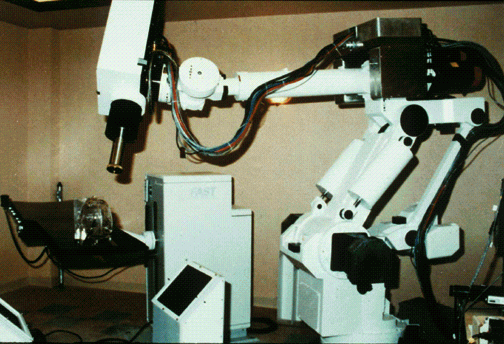
  • 1992: Dr. John Adler comes up with the concept of the CyberKnife which is a robot that that screens and delivers a pre-planned dose of radiation to the tumor of a patient when found
  • 1993: Dante, an 8-legged robot, descend into Mt. Erebrus, Antartica. Its plan was to collect data from the harsh environment as it may similar to the environment on other planets. When it reaches 20 feet, the tether snaps and Dante droops into the crater.
    Dante II
  • 1994: Dante II descends into the crater of Alaskan volcano Mt. Spurr. Its mission was to collect volcanic gas samples an it was considered a success.
  • 1996: RoboTuna was created to study the way fish swim
  • 1996: Chris Campbell and Stuart Wilkinson turn a brewing accident into inspiration. The result of this is a robot named Gastrobot that digests organ mass to produce carbon dioxide and then is used for power. They called their invention the "flatulence engine"
  • 1997: a computer was built by IBm and known as Deep Blue beat world chess champion Garry Kasparov
  • 1997: The first node on the International Space Station is placed in orbit
    International Space Station
  • 1997: The Pathfinder Mission lands of Mars. The robotic rover rolls onto Martian soil
  • 1998: LEGO releases its first Robotics Inventions System
  • 1999: LEGO releases the Robotics Discovery Set
  • 1999: Sony releases the first AIBO, a robotic dog that has the ability to learn, entertain, and communicate with its owner
    ASIMO Humanoid Robot
  • 2000: Honda debuts ASIMO, a humanoid robot
  • 2000: LEGO releases the MINDSTORMS Robotic Invention System 2.0 
  • 2001: The FDA clears CyberKnife to treat tumors anywhere in the body
  • 2004: Epsom release the smallest known robot, standing 7 centimeters and weighing just 10 grams. This robot is a helicopter signed as a flying camera to be used during natural disasters
  • 2005: Cornell University builds the first self-replicating robot


Industrial Robots

Types of Robots:

  • Industrial Robots: these robots are used in the manufacturing environment. An example of these robots are articulated arms. They are specially designed for applications such as welding, material handling, painting and other tasks. 
Robotic Vacuum Cleaner
  • Domestic and Household Robots: these types of robots are basiccally the robots used at home. Some example of these robots include robotic vacuum cleaners, robotic pool cleaners, sweepers, gutter cleaners, and other robots that can do different chores. 

Surgery Robot

  • Medical Robots: these are robots used in medicine and medical institutions. For example, surgery robots
Data Collecting Robot


  • Service Robots: generally, these are robots that do not fall into any other types of usage. Some of these robots include, data gathering robots, robots made to show off technology, robots used for research, etc


Transportation Robot

  • Military Robots: military robots include bomb disposal robots, different transportation robots, reconnaissance drones. These robots can also be used in law enforcement

Robosapien

  • Entertainment Robots: this is very broad category. These types range from toy robots to running alarm clocks. 


Mars Rover


  • Space Robots: these are robots used on the International Space Station, robots used in shuttles, and rovers on Mars


Robots in a Competition
  • Hobby and Competition Robots: these are robots that you create. They are made for fun or used in competitions. 


Robotics Today:

              Transitioning from the past to the present, robots have become more complex an have gained more knowledge. Because of this, robots have helped us to learn more and gather more knowledge of things humans would have never been able to do. Robots help to find solutions to everyday problems. Robots have proved to beneficial to people and especially manufactures. In order for people to continue seeing these benefits, a robot equipment maintenance program was implemented. The most common program is preventive maintenance which is designd to eliminate unexpected breakdowns and increase the life span of the robots and machines. The downside of robots is that they require a lot of maintenance.

The Rise of the Robots:

             "The robots haven't just landed in the workplace-they're expanding skills, moving up the corporate ladder, showing awesome productivity and retention rates, and increasingly shoving aside their human counterparts." Pretty soon, Robots will outthink humans where they will no longer be needed. For example, there is a machine which can make a hamburger in about 10 seconds. This robot can soon replace an entire McDonalds crew. As time passes, robots and machines become for intelligent, specialized, and sophisticated.
              Robotic engineers are designing and creating robots to look, act, and feel more like humans. There are sensors embedded under the skin of the robots to help it react naturally in the environment. 
              Hod Lipson is an engineering professor at Cornell University. He is one of the world's leading expert on artificial intelligence and robotics. His vision of the future was unthinkable until recently. "Could the rapid advances in automation and digital technology provoke social upheaval by eliminating the livelihoods of many people, even as they produce great wealth for others?" For a long time, it was thought that advancements in robots and technologies have been destryoying jobs but also creating new and better one. Now, it is still destroying jobs but creating a smaller amount of better jobs. Robots are gradually creeping into everything from manufacturing to decision making. 


We have always wanted machines to do task for use and make things easier but no one ever thought of that as a bad thing.

Do we own the robots or do the robots own us?

Programing:

Programing is the process of creating a sequence of instructions that tell a computational device,such as a micro controller. The micro controller is a small computer on a single integrated circuit
containing a processor core, memory, and programmable input-ouput peripherals. 
Robotic programing involves designing the controller that governs robot behavior. Because of the growing complexity of robotics, modeling, stimulation, and programing is becoming crucial to understanding how the controller interacts with the robot's environmental perception and mobility. Doing model situations allow for engineers to refine and eliminate errors before developing the hardware prototypes.


Conclusion:

              Robotics is a topic that has many advantages as well as many disadvantages. Over the years, programing and robotics have helped to improve and change the way society thinks as well as live. Over the last century, there was been many new inventions that have helped us for the better and started new eras. For example, when the Soviet Union launched "Sputnik" into space, it was the start of the space race. Robots have many uses and come in many different types. Along with the different types, each robot has a different ability. Each design has a specific use and purpose. Although there are many advantages for robots, there are also disadvantages. Robots are becoming more and more complex causing them to be able to think on their own. Robots are also destroying certain jobs for humans. Certain robots can also become dangerous to humans. Overall, robots have made a huge impact on lives today. They make our lives easier and effect us in so many ways.


Bibliography:

http://robotics.megagiant.com/history.html 
http://www.livescience.com/29379-intelligent-robots-will-overtake-humans.html
http://www.mind.ilstu.edu/curriculum/medical_robotics/robots_in_beginning.php
http://www.allonrobots.com/types-of-robots.html
https://www.robots.com/articles/viewing/robot-equipment-maintenance
http://www.wired.com/brandlab/2015/04/rise-machines-future-lots-robots-jobs-humans/
http://www.futureforall.org/robotics/robotics.htm
http://www.technologyreview.com/featuredstory/538401/who-will-own-the-robots/
http://www.cs.cmu.edu/~minerva/press/realprogress/
http://www.vexrobotics.com/vexedr/software/
http://www.mathworks.com/discovery/robot-programming.html?requestedDomain=www.mathworks.com
http://www.philforhumanity.com/Robots.html